Key points at a glance
- Dachdecker (roofer, § 94 no. 11 GewO) and Spengler (sheet metal worker, a combined craft with coppersmith, § 94 no. 64) are two separate regulated trades, each with its own master exam.
- You may only provide supplementary services of the other trade within narrow limits: at most 15 % of the job and 30 % of annual turnover (§ 32 (1a) GewO). If you regularly do both, you need both licences.
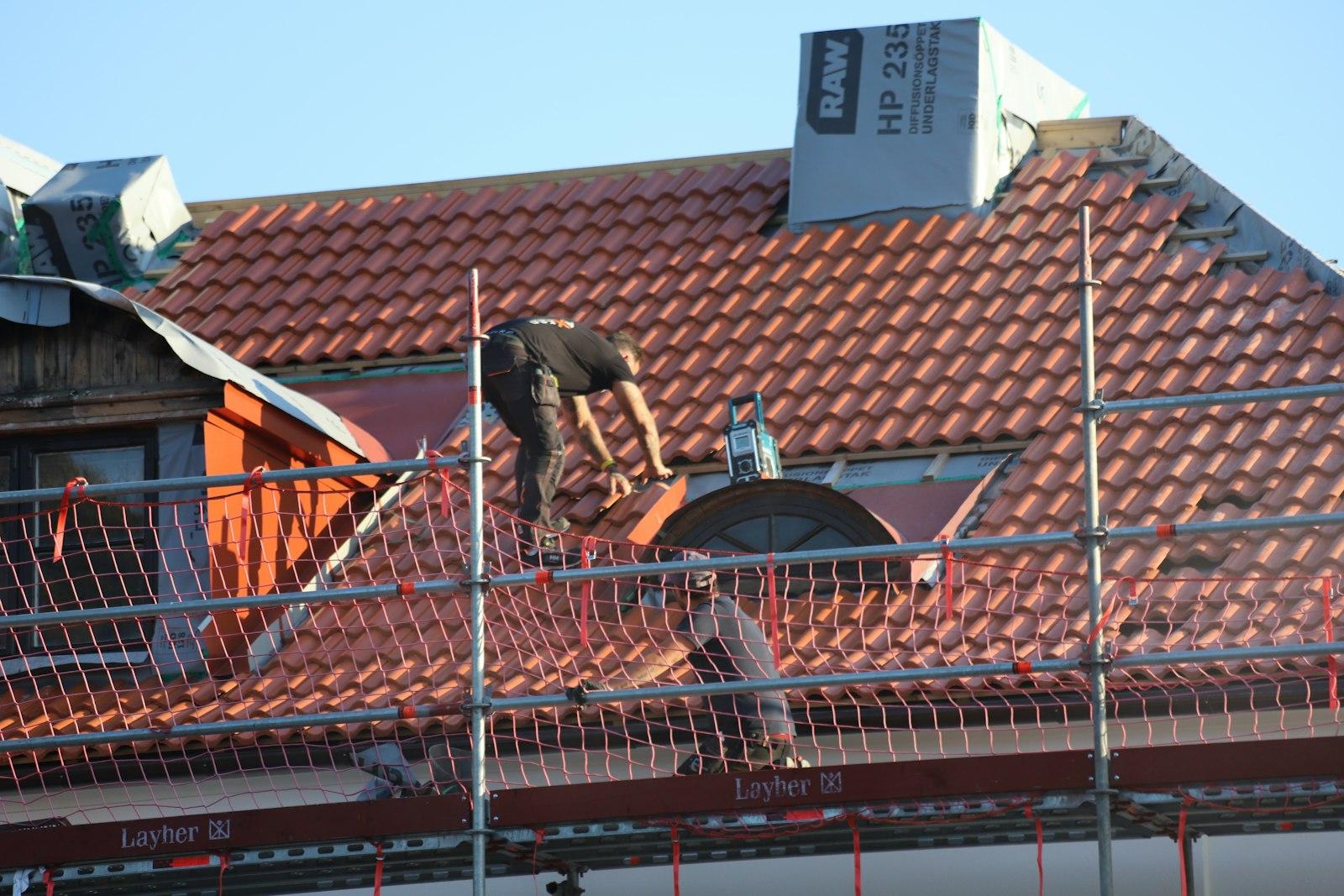
- Above a fall height of 3 m, the Bauarbeiterschutzverordnung (construction workers' protection regulation) requires fall protection or protective structures on roofs, such as roof catch scaffolds on steep roofs.
- Roofing businesses have always been covered by the BUAG, sheet metal businesses since 1 January 2024 (except ventilation and ornamental sheet metal work).
- Liability insurance is not required by law for roofers and Spengler, but it is indispensable: water damage after a leaking flashing quickly costs five figures.
This article is general information, not legal or tax advice. Rules change: check the details with your economic chamber or chamber of crafts, your trade guild or your tax adviser.
Two crafts, clear boundaries
The Gewerbeordnung (Austria's Trade Act) separates roof and metal. The line is not always where customers expect it. The overview below helps with a first classification. In an individual case, the wording of your trade licence decides, and if in doubt, the Landesinnung (regional guild) for roofers, glaziers and Spengler can help.
| Work | Roofer | Spengler |
|---|---|---|
| Pitched roof with clay tiles, concrete tiles, slate, fibre cement | core business | no |
| Flat roof waterproofing with bitumen or synthetic membranes | core business | only as a supplementary service |
| Gutters, downpipes, valleys, chimney flashings | simple flashings as part of the roof covering | core business |
| Standing seam metal roof, sheet metal façade | no | core business |
| Aluminium roof panels (diamonds, shingles) | yes, as a roof covering | yes |
| Roof windows, underlay, insulation above the rafters | yes | only as a supplement |
If you occasionally work into the other trade, you can rely on § 32 (1a) GewO: supplementary services of a regulated trade are allowed if they complement your own work in an economically sensible way, make up no more than 15 % of the individual job, and all supplementary services together do not exceed 30 % of annual turnover. So a roofer may fit the gutter along with a new tiled roof. A sheet metal business that regularly waterproofs entire flat roofs, on the other hand, needs the roofing licence.
Master exam and other routes to a licence
Both trades are crafts (Handwerke). You usually provide the Befähigungsnachweis (proof of competence) with the Meisterprüfung (master craftsman exam), which consists of five modules: the technical modules (practical, oral and written), the trainer exam and the entrepreneur exam. If you have a final apprenticeship exam in the trade, parts are credited. You sit the exam at the Meisterprüfungsstelle (exam office) of your federal state; preparation courses are available at WIFI and the Bauakademien (construction academies).
If you have no master exam but long experience, the trade authority can accept an individual proof of competence under § 19 GewO. For this you submit your apprenticeship certificate, employer references and proof of work you carried out on your own responsibility. The third option is a gewerberechtlicher Geschäftsführer (managing director responsible under trade law) with a master exam who is employed in the business for at least half the normal weekly working hours.
Fall protection: the most important issue on your site
Falls are among the most common causes of serious accidents in construction, and on the roof the risk is highest. The Bauarbeiterschutzverordnung (BauV) governs work on roofs in §§ 87 and 88. The basic rule is:
- On roofs with a pitch of up to 20° and a fall height of more than 3 m, you need fall protection, barriers or protective structures, such as guardrails at the eaves.
- On steeper roofs, the BauV requires suitable protective structures such as roof safety screens or roof catch scaffolds with a protective wall.
- Up to a fall height of 3 m, protection may only be omitted under strict conditions: favourable weather and trained, experienced workers. Above a 45° pitch, personal protective equipment is still mandatory.
- On ordinary roofs, the fall height is measured vertically from the eaves edge to the surface below.
Under the ArbeitnehmerInnenschutzgesetz (ASchG, Employee Protection Act) you must assess and document these hazards, train your people and provide a safety specialist and occupational health care. For businesses with up to 50 employees, AUVAsicher does this free of charge. Most roofing businesses hire façade scaffolding including erection and dismantling, while their own crew often puts up the roof catch scaffold. Include scaffolding costs in every quote: a customer understands a separate item for "safety equipment" better than an unexplained high price per square metre.
BUAK: for sheet metal businesses too since 2024
Roofing businesses have always been covered by the Bauarbeiter-Urlaubs- und Abfertigungsgesetz (BUAG, construction workers' holiday and severance act, § 2 (1) (c)). For Spengler it was long unclear what applied, until the Verwaltungsgerichtshof (Supreme Administrative Court) ruled in 2023 that roofing with prefabricated metal panels falls under the BUAG. Since 1 January 2024, sheet metal businesses have therefore been expressly included, with a separate transitional rule in § 43 BUAG. Ventilation and ornamental sheet metal businesses remain exempt.
For you this means: every worker who works on the roof is registered with the BUAK (the construction workers' holiday and severance fund), and you pay monthly surcharges for holiday, severance and bridging pay. Build this into your hourly rate. Which collective agreement applies for wages and allowances depends on your licence. The Landesinnung will tell you which one is relevant for your business.
Storms, hail, emergency call-outs: the repair business
After a storm, the phone rings non-stop in every roofing business. That is a good way in for founders, provided you prepare a few things:
Offer emergency protection
Tarpaulins, battens, spare tiles and sheet metal in the van, so you can make a roof watertight the same day. Invoice emergency protection as a separate service with call-out charge and hourly rate.
Document the damage
Photos from above and below, date, affected area. The customer's insurer needs these documents, and you protect yourself from accusations of having made the damage worse.
Write a cost estimate
A cost estimate given to consumers is binding unless you expressly state otherwise (§ 5 KSchG, Consumer Protection Act). You may only charge for it if you said so beforehand.
Work with loss adjusters
For larger claims, the insurer sends an expert. Be there for the appointment: it saves follow-up questions and speeds up approval.
Repair and invoice
The invoice goes to the customer, not the insurer, unless there is a written assignment. Explain this at the start so there is no dispute later.
Insurance for a roofing business
| Insurance | What for | Premium approx. |
|---|---|---|
| Business liability | Personal injury and property damage, e.g. water damage after rain on an open roof | €1,500 – €4,000 |
| Damage to the work and the object worked on | Damage to the building you are working on (often an add-on to liability cover) | in the package |
| Machinery and tools insurance | Theft from the scaffold, damage to crane or hoist | €500 – €1,500 |
| Vehicle and trailer | Flatbed, van, trailer-mounted roofing hoist | €800 – €2,000 per vehicle |
| Business interruption | Loss of income after an accident or a fire in the workshop | based on turnover |
You yourself have accident cover through the SVS (social insurance for the self-employed), your employees through the AUVA. Also consider private accident or occupational disability insurance: a shoulder injury ends work on the roof faster than in almost any other job.
What starting up costs
A roofing business with two to three people can manage with modest capital if you hire the crane and façade scaffolding. Roughly (net, as of November 2026): flatbed or van with trailer €30,000 to €50,000, roofing hoist €4,000 to €9,000, tools and cordless equipment €6,000 to €12,000, protective equipment and roof catch scaffold €5,000 to €10,000. A sheet metal business also needs a folding machine, a rolling machine and seaming tools, €10,000 to €40,000 depending on size, plus a small workshop. Then add storage, insurance and a reserve for winter, when less work happens on roofs.
How to get it right
- Take photos at every site visit and use them in the quote
- Show safety measures as a separate item
- Offer maintenance contracts for gutters and flat roofs: they bring work in winter
Better not
- Regularly waterproof flat roofs if you only hold the Spengler licence
- Repair a gutter "just quickly" without fall protection
- Give cost estimates without stating they are non-binding if you need leeway
Be found when the next storm hits
We create a free draft of your website with emergency number, services and reference roofs. You see the result after three days.
A free draft of your future business website.
Visible online: emergency service and reference roofs
Anyone searching for "roofer near me" after a storm calls the first two results. A well-kept Google Business Profile with opening hours, emergency number and photos is therefore a must. On your website, show finished roofs with material and location, and state which trades you hold. The imprint needs your trade licences and the trade authority; more on this under mandatory information in Austria. The imprint generator writes the right text, and with the review QR code you ask satisfied customers for a review after handover.
Checklist: roofing business in Austria
- Trade chosen: roofer, Spengler or both
- Proof of competence or gewerberechtlicher Geschäftsführer
- Trade registered via GISA, Landesinnung and SVS sorted
- BUAK registration for all workers
- Fall hazard assessment and AUVAsicher support
- Business liability insurance including damage to the work
- Emergency protection material and photo documentation prepared
- Google profile and website with emergency number
The steps that apply to every trades business, from SVS to tax number, are in the guide starting a trades business in Austria.
Sources
- RIS – Gewerbeordnung 1994, § 94 (regulated trades)
- RIS – Gewerbeordnung 1994, § 32 (ancillary rights)
- RIS – Bauarbeiterschutzverordnung
- RIS – Bauarbeiter-Urlaubs- und Abfertigungsgesetz
- BUAK – FAQs on including sheet metal businesses (PDF)
- WKO – ventilation, ornamental and vehicle Spengler and the BUAK
- RIS – Konsumentenschutzgesetz, § 5
- AUVA – AUVAsicher