Key points at a glance
- Under trade law, the metalworker's trade is called Metalltechnik für Metall- und Maschinenbau (metal technology for metal and mechanical engineering) and is part of a combined craft (§ 94 no. 59 GewO). You usually provide the Befähigungsnachweis (proof of competence) with the master exam.
- Your workshop is a Betriebsanlage (commercial facility). If noise, welding fumes or delivery traffic could affect neighbours, you need a permit under § 74 GewO before you start operating.
- Load-bearing steel and aluminium components that you place on the market need CE marking under EN 1090-1 with certified factory production control.
- For your welders, qualification tests under EN ISO 9606-1 are the standard; EN 1090 also requires a designated welding coordinator.
- Metal technology businesses generally do not fall under the BUAG. An exception applies to installing certain ventilated curtain wall façades.
This article is general information, not legal or tax advice. Rules change: check the details with your economic chamber or chamber of crafts, your trade guild or your tax adviser.
Which trade to register
The Gewerbeordnung (Austria's Trade Act) no longer uses the term "Schlosser" (locksmith or metalworker). Since the trades were merged, it is called Metalltechnik für Metall- und Maschinenbau. Together with "Metalltechnik für Schmiede und Fahrzeugbau" (smiths and vehicle construction) and "Metalltechnik für Land- und Baumaschinen" (agricultural and construction machinery), it forms a combined craft (§ 94 no. 59 GewO). For a classic structural and decorative metalwork shop making railings, gates, stairs, steel structures and repairs, the metal and mechanical engineering trade is the right one.
You provide proof of competence in one of these ways:
- Master exam in metal technology with five modules: master piece (practical), technical interview (oral), project work (written), plus the trainer and entrepreneur exams. With a completed apprenticeship in a metal technology modular trade, parts are credited.
- Other training routes under the access regulation, such as a relevant HTL (technical college), Werkmeisterschule (foreman school) or a degree combined with work experience. The Meisterprüfungsstelle (exam office) or trade authority will tell you the exact periods.
- Individual proof of competence (§ 19 GewO), if you can show equivalent knowledge through experience in highly skilled work. The district authority decides case by case.
- Gewerberechtlicher Geschäftsführer (managing director responsible under trade law) with a master exam, if you do not yet meet the requirements yourself.
The workshop: location and operating permit
A metalwork shop is loud, creates dust when grinding and produces welding fumes. Under § 74 GewO, a commercial facility needs a permit if it can disturb or endanger neighbours through noise, smell, smoke or vibration. With a metal workshop, that is almost always the case. Smaller facilities often go through the simplified procedure under § 359b GewO, which is faster. Before you sign a lease, clarify three things:
Check the zoning
The zoning plan (Flächenwidmungsplan) must allow commercial use. A hall in a residential area is difficult; in a commercial or industrial zone it is usually no problem.
Preliminary meeting with the authority
District authorities and municipal offices hold project consultation days. Bring a floor plan, a list of machines and your planned working hours. There you will learn which documents and expert reports are needed.
Submit and meet the conditions
Typical conditions cover noise protection (doors closed while grinding), extraction during welding, fire protection and storage of gas cylinders. In the simplified procedure, expect a few weeks; in the ordinary procedure, several months.
If you take over an existing metalwork shop, check whether the permit matches your planned use. A new laser cutting system or a paint booth may require an amended permit. For staff, the ArbeitnehmerInnenschutzgesetz (Employee Protection Act) applies: assessment of welding fumes, noise and machinery, training and preventive services. For businesses with up to 50 employees, AUVAsicher provides occupational safety and health support free of charge.
EN 1090 and CE marking: when you must be certified
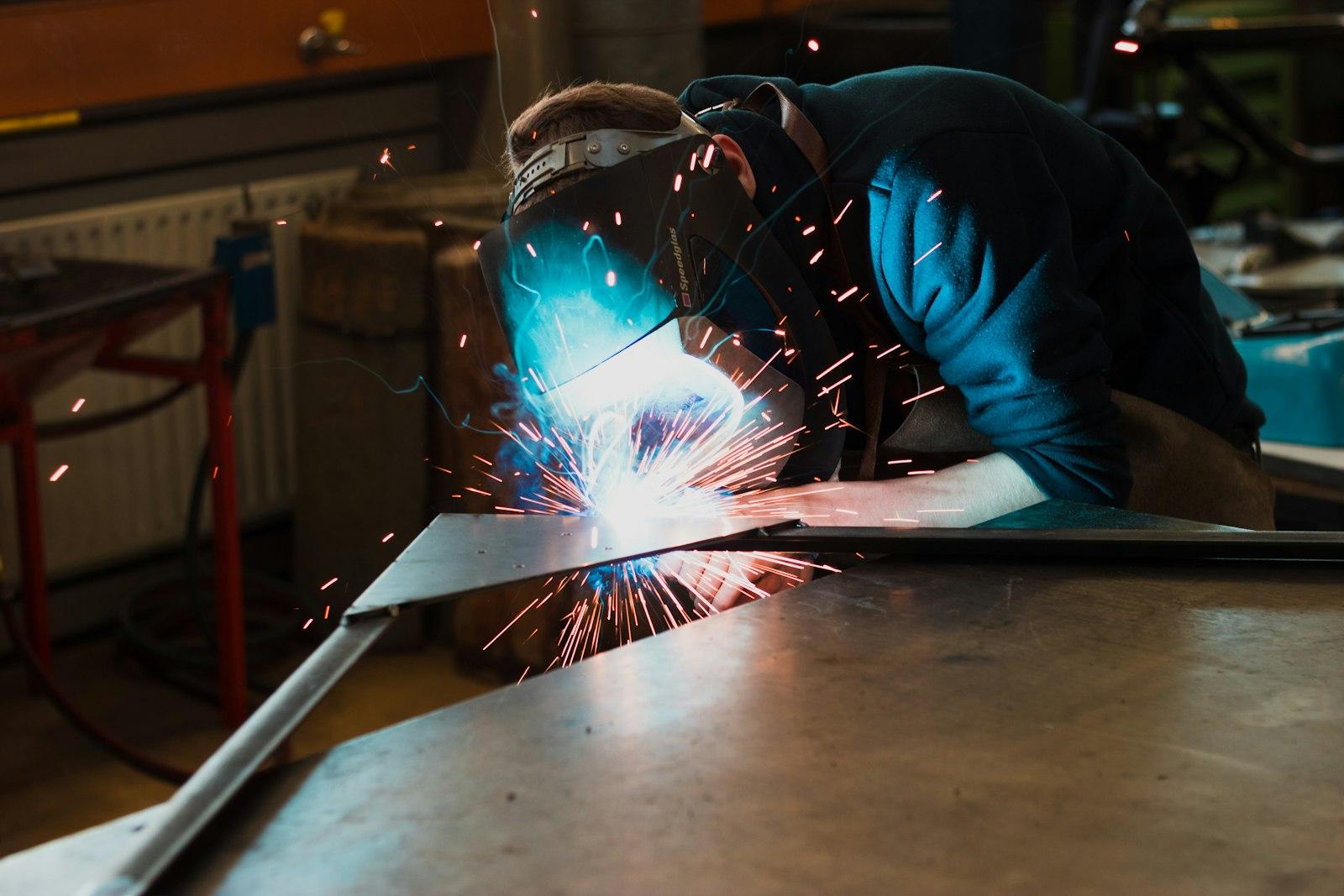
If you manufacture load-bearing components or kits made of steel or aluminium and place them on the market, you must provide them with a declaration of performance and CE marking under the harmonised standard EN 1090-1. Examples include steel beams, columns, stair stringers, balcony and canopy structures and carports with a structural function. The basis is EU construction products law: the new Construction Products Regulation (EU) 2024/3110 has applied since 8 January 2026 and is gradually replacing Regulation 305/2011. Standards harmonised under the old regulation remain relevant during the transition period, so EN 1090-1 still applies.
| Class | Typical components | What it means for your business |
|---|---|---|
| EXC1 | simple structures with low consequences of failure, such as agricultural buildings; according to common examples also stairs and railings in housing | entry level, lower requirements for welding coordination |
| EXC2 | most building construction: halls, canopies, balconies, platforms | usually the goal for a structural metalwork shop; welding coordinator with basic or specific knowledge depending on material and plate thickness |
| EXC3 | bridges, stadiums, tall structures | welding coordinator with comprehensive knowledge (welding engineer), rarely for small businesses |
| EXC4 | structures with very high consequences of failure | specialist businesses |
For certification you set up factory production control (FPC): documented procedures from ordering material with an inspection certificate to final inspection, batch traceability, monitoring of measuring equipment and welding procedure specifications (WPS). A notified body, such as a TÜV organisation or a welding test institute, audits your business and then monitors it regularly. For consulting, the initial audit and procedure qualifications in the first year, expect roughly €5,000 to €12,000, followed by ongoing surveillance costs (guide figures, as of November 2026).
Welding certificates for your team
The welder qualification test under EN ISO 9606-1 (steel) or 9606-2 (aluminium) applies to a specific process, position and material range, for example MAG welding of fillet welds on structural steel. It must be confirmed regularly and, depending on the type of renewal, retested. For the welding coordinator in an EN 1090 business, training to an international standard is usual: International Welding Specialist (IWS), Technologist (IWT) or Engineer (IWE). Courses are offered by WIFI and welding training centres, for example. If you weld yourself as a founder, the welding specialist course often pays off: in many EXC2 cases it lets you act as coordinator yourself.
Staff: collective agreement and BUAG
Under § 2 (5) BUAG, metal technology businesses are exempt from the Bauarbeiter-Urlaubs- und Abfertigungsgesetz (construction workers' holiday and severance act). Your fitters are therefore not covered by the BUAK, and you handle holiday and severance yourself. An important exception is in § 2 (6): if you install ventilated curtain wall façades, this may fall under the BUAG depending on the façade element and size. If you enter this business, clarify it with the BUAK in advance. Wages and allowances are set by the collective agreement for the metal trades. Metal technology apprentices are in demand, and a training workshop is an argument that helps you win skilled workers. Tips in the article on finding employees.
What the workshop costs
| Equipment | new approx. | used or alternative |
|---|---|---|
| MAG welder, plus TIG for stainless steel | €4,000 – €12,000 | used from around €1,500 per unit |
| Metal band saw, pillar drill | €5,000 – €15,000 | used industrial machines |
| Welding table with clamping system | €3,000 – €8,000 | build your own |
| Press brake or folding machine | €15,000 – €60,000 | buy in folded parts at first |
| Overhead crane or gantry crane | €8,000 – €25,000 | forklift, chain hoist |
| Welding fume extraction | €3,000 – €10,000 | mobile extraction to start with |
| Van with tarpaulin or flatbed and trailer | €30,000 – €50,000 | leasing |
| EN 1090 certification in the first year | €5,000 – €12,000 | only when needed |
Almost all small metalwork shops buy in laser cutting, galvanising and powder coating. The hall and electricity are the big running costs: for 300 to 500 m² of workshop with an office, rents vary considerably by region. Also, do not count on the small business scheme: with a threshold of €55,000 annual turnover (as of November 2026), steel prices and two people quickly take you past it.
How to get it right
- Design railings and stairs to the requirements of OIB Guideline 4 and your federal state's building code (height, openings, protection against climbing)
- Have the customer approve the workshop drawing before you cut
- File the material certificates for every delivery, even without EN 1090
Better not
- Rent a hall before the zoning is clear
- Supply load-bearing canopies to developers without CE marking
- Let people without a valid qualification test do welding work
Show off your railings, gates and stairs
We build you a free draft of your website with services, references and workshop. In three days you see how your metalwork shop comes across online.
A free draft of your future business website.
Where your first jobs come from
Metalwork shops have two customer groups: private customers who want a railing, a gate or a fence, and building firms, joineries and architects looking for reliable suppliers. You find private customers through Google and recommendations; for professionals, meeting deadlines and certificates count. Your website should therefore show both: photos of finished work with material and finish, and a clear list of what you make, including your EN 1090 class once you have it. Your imprint follows the mandatory information in Austria, and the imprint generator supplies the text. With the business card generator you have cards ready for your first site meeting.
Checklist: metalwork shop in Austria
- Metalltechnik für Metall- und Maschinenbau trade, proof of competence clarified
- Workshop with suitable zoning found
- Operating permit applied for or in place
- Trade registered via GISA, WKO and SVS sorted
- Welder qualifications under EN ISO 9606 up to date
- Decision on EN 1090 certification and execution class
- Assessment of welding fumes, noise, machinery and AUVAsicher
- Website with references and services
The general founding steps, from legal form to tax office, are in the guide starting a trades business in Austria.
Sources
- RIS – Gewerbeordnung 1994, § 94 (regulated trades)
- RIS – Gewerbeordnung 1994, § 74 (commercial facilities)
- RIS – Gewerbeordnung 1994, § 32 (ancillary rights)
- WKO – access to the Metalltechnik trade
- WKO – Meisterprüfung Metalltechnik
- RIS – Bauarbeiter-Urlaubs- und Abfertigungsgesetz
- OIB – OIB Guidelines 2023
- TÜV Rheinland Austria – EN 1090 certification
- USP – small businesses (Kleinunternehmen)