Key points at a glance
- Dachdecker (roofer) is no. 4 and Klempner (sheet metal plumber) no. 23 in Annex A of the Handwerksordnung (Crafts Code). Both require a licence; for the Handwerksrolle (register of crafts) you need a master's certificate or equivalent proof.
- Roofing businesses do not pay into SOKA-BAU but into SOKA-DACH in Wiesbaden: a 12.40 % social fund contribution plus a 1.60 % winter employment levy on gross wages.
- A sector minimum wage applies: in 2026, €14.96 (wage group 1) and €16.60 (wage group 2, journeymen); in 2027, wage group 2 rises to €17.10.
- The ZVDH technical rules (Fachregeln) count as recognised rules of the art. If you deviate from them, in a dispute you have to prove that your solution is equivalent.
- On building sites, fall protection is generally mandatory from a fall height of more than 2 m (ASR A2.1), with a narrow exception up to 3 m for small, shallow roof areas.
This article is general information, not legal or tax advice. Rules change: check the details with your economic chamber or chamber of crafts, your trade guild or your tax adviser.
Where the jobs come from
Four areas carry most roofing businesses: pitched roof renovation with insulation, flat roof waterproofing for commercial buildings and housing complexes, photovoltaic mounting structures and repairs after storms or hail. For a new business, the mix is what matters. Renovations bring predictable turnover, repairs quickly bring new contacts, and if you have fixed someone's gutter once, you often get the new roof too. Before you start, decide which area you want to own, because your tools, staff and website depend on it.
Meisterpflicht for roofers and Klempner
For entry in the Handwerksrolle, the Handwerkskammer (chamber of crafts) names several routes: the master's certificate in the roofing trade, an equivalent qualification such as a civil engineering degree in a suitable field, an employed master craftsperson as operations manager (Betriebsleiter), the Ausübungsberechtigung (practice authorisation) under § 7b HwO (journeyman's exam and six years of work, four of them in a senior position) or an Ausnahmebewilligung (exception permit) under § 8 HwO. Full-time master's school takes a few months, part-time correspondingly longer. Aufstiegs-BAföG (the state grant for advanced vocational training) supports the course and exam with a grant and a low-interest loan.
Metal gutters, valleys and flashings in connection with the roof covering are also roofers' work. § 5 HwO allows work in other crafts that is technically or professionally connected with your own job or complements it economically. A pure double standing seam metal roof or a sheet metal façade as a separate job, however, is Klempner work. If you want to offer both permanently, register both crafts or hire a master Klempner as operations manager.
Registration: from the trade office to SOKA-DACH
Handwerkskammer
Entry in the Handwerksrolle for Dachdecker (and Klempner if needed). The chamber also advises on support programmes for start-ups and business takeovers.
Trade office and tax office
Register the trade, then submit the tax registration questionnaire. Apply for the exemption certificate under § 48b EStG at the same time, otherwise business clients withhold 15 % Bauabzugsteuer (construction withholding tax).
BG BAU
Register within one week of starting the business. Owners are not automatically insured; voluntary owner's insurance is more than a formality when you work on roofs.
SOKA-DACH
With your first employee covered by the collective agreements, you register the business with the roofing trade's social fund and report gross wages every month.
Guild (voluntary)
The roofers' Innung (guild) is not compulsory. But it offers collective agreement updates, model contracts, cheaper access to the technical rules and contacts with colleagues for large jobs.
SOKA-DACH and minimum wage: your non-wage labour costs
SOKA-DACH consists of the wage equalisation fund, the supplementary pension fund and the central pension scheme of the roofing trade. Among other things, it pays contributions towards the 13th month's pay, the collectively agreed supplementary pension, training grants and loss-of-earnings pay. Since March 2025 the contribution has been the same nationwide:
| Component | Rate |
|---|---|
| Vocational training | 2.00 % |
| Supplementary pension | 3.20 % |
| Part of the 13th month's pay | 6.20 % |
| Employment protection | 1.00 % |
| Total social fund contribution | 12.40 % |
| Winter employment levy | 1.60 % |
| Total | 14.00 % |
A worked example: you employ two journeymen and a labourer with combined gross wages of €150,000 a year. Around €21,000 then goes to SOKA-DACH, on top of statutory social security contributions and the BG contribution. In return, part of the 13th month's pay is reimbursed and you can use seasonal short-time allowance in bad weather instead of laying people off.
For wages, the Dachdeckerarbeitsbedingungenverordnung (roofing working conditions ordinance) sets a sector minimum wage above the statutory minimum: in 2026, €14.96 for unskilled workers (wage group 1) and €16.60 for journeymen (wage group 2). Wage group 2 rises to €17.10 in 2027 and €17.60 in 2028. Customs checks this on building sites, and working time records are mandatory.
ZVDH technical rules: your technical benchmark
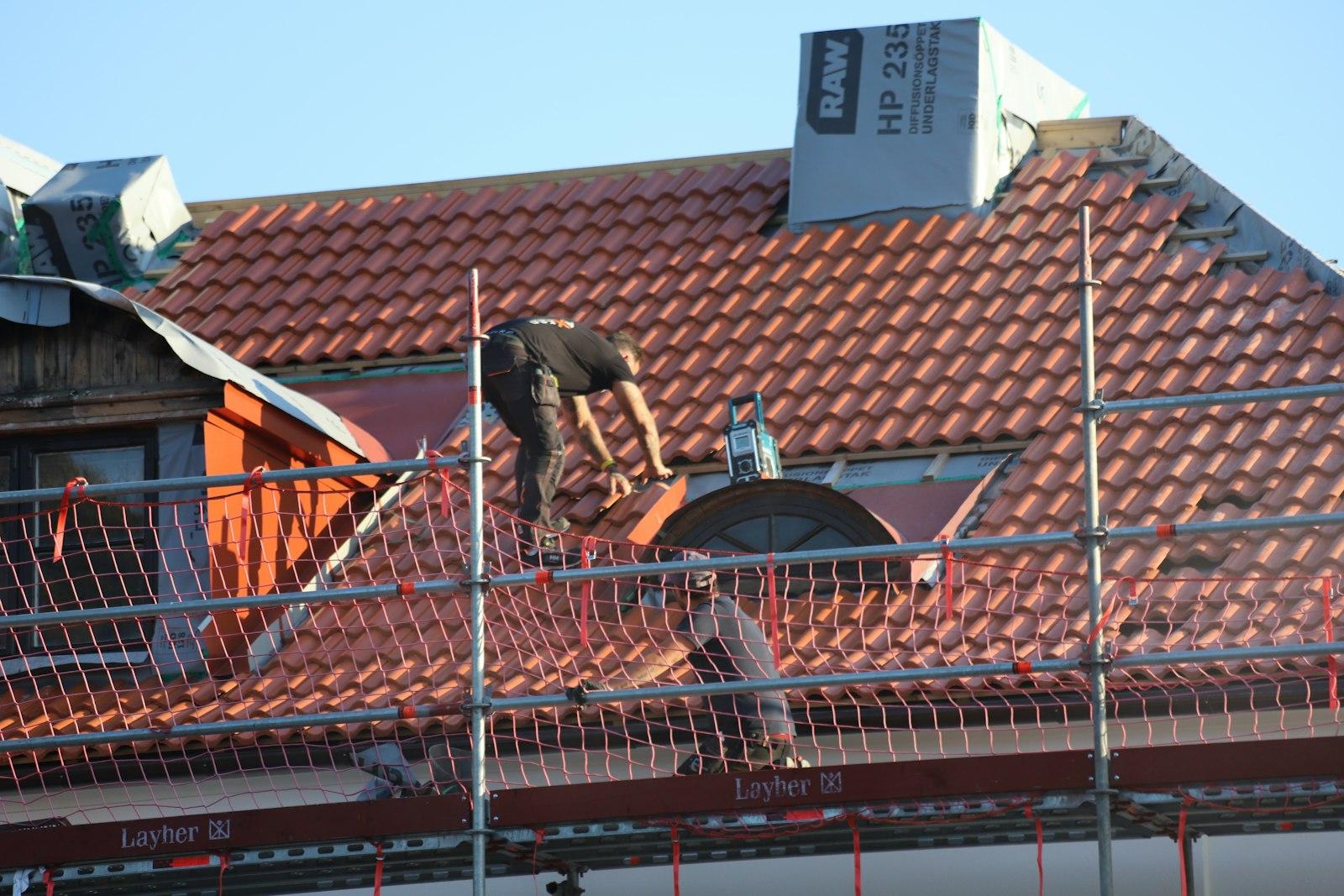
The rules of the German roofing trade, published by the central association (ZVDH), consist of basic rules, technical rules, notes and guidance sheets, for example on roof coverings with tiles or slate, on waterproofing (the flat roof guideline) or on metal work. Courts and experts treat them as recognised rules of the art. For you this means: a quote that provides for a lower roof pitch, a shorter overlap or a different underlay than the technical rule needs a written note to the customer and a justification. Otherwise you are liable if damage occurs, even if the customer wanted the cheaper solution.
Fall protection: rules and costs
The technical rule for workplaces ASR A2.1 generally requires protection against falls on building sites from a fall height of more than 2 m. An exception up to 3 m only exists for roof areas with a pitch of up to 22.5° and no more than 50 m² of floor area, and under further conditions. Technical protection (edge protection, catch scaffolds, nets) always takes priority over personal protective equipment. BG BAU offers occupational safety bonuses that cover part of the cost of, for example, roof safety walls or anchor devices. Ask about the current conditions before you buy.
- Risk assessment for every site, not just once for the business
- Staff training at least once a year, documented
- Personal fall protection only with a rescue plan: anyone hanging in a harness must be freed within minutes
- With several firms on site: coordination under the Baustellenverordnung (construction site ordinance) by the client
Start-up costs
| Item | approx. | Tip |
|---|---|---|
| Crew cab flatbed | €35,000 – €55,000 | used or leasing |
| Inclined hoist or roofing hoist | €5,000 – €12,000 | hire a crane at first |
| Edge protection, roof safety wall, PPE | €6,000 – €15,000 | check the BG BAU safety bonus |
| Tools, cordless and cutting tools, membrane welder | €8,000 – €15,000 | one manufacturer's system saves on batteries |
| Storage area with container | €300 – €1,000 a month | also at a builders' merchant |
| Technical rules, software, measurement app | €800 – €3,000 a year | guild members pay less |
If you take over an existing business, the sums look different: vehicles, scaffolding and customer base are already there, but you pay a purchase price. Many chambers of crafts run business exchanges, and in the roofing trade in particular many owners are looking for a successor.

How to get it right
- Refer to the applicable technical rule in your quote
- Collect before and after photos of every roof
- Offer maintenance contracts for flat roofs: commercial customers value them
Better not
- Price below minimum wage because labourers "only help out briefly"
- Connect inverters and meter cabinets yourself
- Agree deviations from the technical rules only verbally
Your roofs as references, online
We build you a free draft of your website with services, service area and projects. You can view it in three days.
A free draft of your future business website.
Winning customers
For roof renovations, owners usually get three quotes and decide on trust. So show real roofs from your region on your website, explain the process from site visit to handover and name your service area. How this works in search is explained in the article on local SEO. Your imprint follows the mandatory information for Germany, including chamber and professional title. The imprint generator creates the text. If you want to put "Meisterbetrieb" (master craftsman business) on your van, the rules are in the article on advertising for trades businesses.
Checklist: roofing business in Germany
- Handwerksrolle: Dachdecker, Klempner if needed
- Trade registration, tax registration, exemption certificate
- BG BAU within one week, owner's insurance
- SOKA-DACH registration with the first employee
- Hourly rate with minimum wage, 14 % SOKA-DACH and downtime
- ZVDH technical rules to hand
- Fall protection and rescue plan
- Partner business for the PV electrical connection
What applies to every trades business, from legal form to health insurance, is in the guide starting a trades business in Germany.
Sources
- Handwerksordnung, Annex A
- Handwerksordnung, § 5
- Handwerksordnung, § 7b
- SOKA-DACH – contribution
- Zoll – overview of sector minimum wages
- BG BAU – compulsory insurance for businesses
- SGB VII, § 192 (duty to register)
- EStG, § 48b (Freistellungsbescheinigung)
- ZVDH – Zentralverband des Deutschen Dachdeckerhandwerks